
 Автор:
Cacao capsules vs ceremonial cacao is a practical comparison for anyone who enjoys the idea of cacao but does not want to prepare a drink every morning. Both products originate from Theobroma cacao, yet their formats, preparation requirements, taste, and intended uses differ.
Cacao capsules offer a pre-measured botanical supplement that can be swallowed without mixing ingredients. Ceremonial cacao is commonly sold as a solid paste, block, or disc made from ground cacao beans. It is typically prepared as a rich drink and may be part of a personal or group ritual.
Secrets Of The Tribe offers Cacao Capsules containing organic cacao beans. A useful comparison with ceremonial cacao should focus on verified ingredients, product format, and the actual experience of using each preparation, rather than assuming they are equivalent.
This guide explains the practical differences and helps you decide whether a capsule fits your routine or whether preparing a cacao drink is an important part of what you want.
What Is the Main Difference Between Cacao Capsules and Ceremonial Cacao?
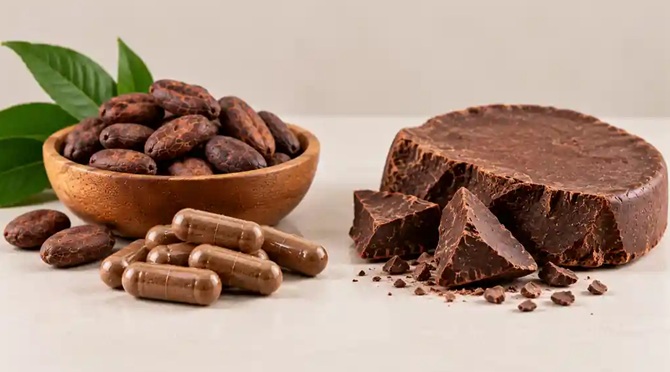
Cacao capsules are dietary supplements designed for convenient use, while ceremonial cacao is generally a cacao-based food preparation intended for making a drink. Both can originate from the same botanical species, but that does not make their servings or finished compositions identical.
Cacao Capsules vs Ceremonial Cacao: Quick Comparison
| Characteristic | Cacao Capsules | Ceremonial Cacao |
|---|---|---|
| Botanical source | Theobroma cacao | Theobroma cacao |
| Typical raw material | Processed cacao seed material | Ground cacao nibs |
| Product format | Capsules | Paste, block, discs, or pieces |
| Primary intended use | Dietary supplement | Prepared food or beverage |
| Preparation required | None beyond taking as directed | Usually heating and mixing |
| Typical serving format | Number of capsules | Measured portion of cacao mass |
| Taste experience | Usually minimal when swallowed intact | Rich, chocolate-like, often bitter |
| Texture | Encapsulated material | Thick, rich drink when prepared |
| Portability | Convenient without mixing equipment | Portable as a solid, but preparation is needed |
| Social ritual | Not inherent to the format | May involve preparation and sharing |
| Automatically equivalent? | No | No |
These differences describe typical commercial formats. Individual products may use different processing methods, additional ingredients, and serving instructions.
What Exactly Is Ceremonial Cacao?
Ceremonial cacao usually refers to cacao mass or paste marketed for drinking, often with an emphasis on its origin, processing, and cultural context. The phrase does not identify a separate botanical species.
Botanical Identity
Theobroma cacao is a tropical tree belonging to the Malvaceae family. Its fruits contain seeds commonly called cacao beans.
These seeds form the basis of cocoa powder, chocolate, cacao paste, and various botanical supplements.
Ceremonial cacao generally uses ground cacao nibs, the edible portions of the seeds after their outer shells have been removed.
Cacao Paste and Cacao Mass
Many ceremonial cacao products are sold as solid cacao paste. The material is made by grinding cacao nibs into a smooth mass containing naturally occurring cocoa butter.
Depending on the producer, the beans may undergo fermentation, drying, roasting, or other processing before grinding.
The paste can solidify into blocks or discs at room temperature. Portions are then melted or mixed into a beverage.
Cacao mass is also called cocoa liquor, but the term liquor does not mean that the ingredient contains alcoholic beverages.
Does Ceremonial Grade Have an Official Definition?
There is no universally enforced regulatory grading standard defining what qualifies as ceremonial cacao. Producers may use the term to describe sourcing practices, minimal processing, traditional preparation, or intended use.
Independent certification initiatives exist, but the words ceremonial cacao do not automatically confirm a particular cacao variety, processing method, or chemical composition.
Evaluate the ingredients, origin, manufacturing details, and available quality documentation rather than relying on the word ceremonial alone.
How Are Cacao Capsules Different From Cacao Paste?
Cacao capsules and cacao paste can originate from the same seeds, but manufacturers prepare them for different uses.
Cacao Capsule Preparation
A manufacturer processes suitable cacao material into a form that can be enclosed inside capsules.
The material may be powdered botanical matter or a specified extract, depending on the product.
The finished supplement includes a capsule shell and a labeled serving. Its formulation should be checked rather than inferred from general cacao processing methods.
Ceremonial Cacao Preparation
Whole cacao paste is commonly produced by grinding processed cacao nibs without first separating cocoa butter from the cocoa solids.
This retained fat gives cacao mass its distinctive texture and helps create a rich beverage.
Some commercial products include additional ingredients. Others contain only cacao mass.
Why Cocoa Powder Is Another Category
Cocoa powder is generally produced after part of the cocoa butter has been pressed from cacao mass.
It is therefore different from whole cacao paste. This matters when comparing a full-fat cacao block with ordinary cocoa powder.
However, cacao capsules should not automatically be considered fat-free. Their actual composition depends on the botanical material and processing method used.
Do Cacao Capsules Require Any Drink Preparation?
No. Capsules are designed for use without preparing a cacao beverage. Their main practical advantage is that the botanical ingredient comes in a pre-measured format.
Using Capsules
Capsules can be taken according to the manufacturer’s suggested serving instructions.
There is no need to melt cacao, heat water, whisk a mixture, or clean preparation equipment afterward.
This can appeal to someone who prefers a short routine that fits alongside a regular meal.
Preparing Ceremonial Cacao
Preparing ceremonial cacao usually involves measuring a portion of cacao paste, combining it with warm water or another suitable liquid, and mixing until the cacao disperses.
Some people use a whisk or blender to create a smoother texture. Others add spices or other ingredients according to personal preference.
The specific method varies between products and traditions. Follow the preparation instructions supplied with the cacao.
Why Preparation Time Matters
A prepared drink requires more steps than swallowing capsules. It also provides an experience that capsules do not reproduce.
For someone who values convenience above taste and preparation, capsules are the simpler format.
Do Cacao Capsules Taste Like Ceremonial Cacao?
No. Capsules generally minimize direct exposure to cacao flavor, while ceremonial cacao is specifically prepared to be consumed as a beverage.
The Taste of Ceremonial Cacao
Unsweetened cacao paste usually has a concentrated chocolate-like flavor with noticeable bitterness.
Depending on the beans and processing, it may also have earthy, fruity, nutty, or roasted notes.
Its natural cocoa butter contributes to a thick, rich mouthfeel when the paste is prepared as a drink.
The Taste of Cacao Capsules
Capsules enclose the botanical material inside a shell. When swallowed intact, they generally limit direct contact between the contents and the tongue.
Some people may notice a mild aftertaste, but the format does not provide the same sensory experience as drinking cacao.
If the flavor and texture are what you enjoy most about cacao, capsules are not a direct replacement.
Can Cacao Capsules Replace a Ceremonial Cacao Ritual?
Capsules can replace the preparation step for someone seeking a convenient cacao supplement, but they cannot reproduce the complete experience of drinking ceremonial cacao.
The Beverage Experience
A prepared cacao drink involves aroma, flavor, temperature, and texture.
Choosing ingredients, mixing the beverage, and sitting down to drink it may also be part of a person’s routine.
Capsules remove most of these elements. They provide a different format rather than a miniature version of the beverage experience.
The Cultural Context
Cacao has a long history in Indigenous cultures of the Americas, including important ceremonial and social roles in several Mesoamerican societies.
Historical practices differed between communities and periods. Contemporary cacao gatherings also vary widely and should not all be presented as identical to historical ceremonies.
A dietary supplement containing cacao should not be described as reproducing these cultural traditions.
Personal Routine vs Ceremony
Someone who wants a simple personal routine may prefer capsules.
Someone who values the preparation, sharing, and experience of a cacao drink may find that ceremonial cacao better matches those preferences.
Neither choice needs to be presented as superior. They serve different purposes.
Do Cacao Capsules Contain the Same Compounds as Ceremonial Cacao?
Both can contain naturally occurring cacao constituents, but their exact concentrations are not automatically equivalent.
Cacao seeds naturally contain theobromine, caffeine, and polyphenols, including flavanols such as epicatechin and catechin.
Theobromine and Caffeine
Theobromine is generally the predominant methylxanthine in cacao seeds. Caffeine also occurs naturally.
Their quantities vary with cacao variety, processing, and the amount of botanical material consumed.
A capsule serving cannot be assumed to contain the same quantity as a cup prepared from cacao paste.
Cocoa Flavanols
Cacao contains flavanols and related polyphenols. Processing methods can change the quantities present in a finished product.
Fermentation, drying, roasting, and additional manufacturing steps can influence the constituent profile.
The word ceremonial does not establish a standardized flavanol concentration, just as the word capsule does not establish one.
Why Equal Serving Counts Are Misleading
Ceremonial cacao is generally measured by the weight of paste used in a drink. Capsules are measured according to the manufacturer’s labeled serving.
These formats should not be compared by assuming that one capsule equals a particular amount of cacao paste.
Verified information about botanical weight, processing, and constituent quantities is needed for a meaningful comparison.
Which Format Is More Convenient for Travel and Everyday Use?
Capsules are generally more convenient when minimal preparation and portability are priorities.
At Home
A capsule routine does not require separate preparation equipment. It can fit alongside meals according to the product directions.
Ceremonial cacao requires time to prepare but offers a drink that may be enjoyed slowly.
At Work
Capsules are usually easier to carry because they do not require a container for a prepared cacao beverage.
Cacao paste can be transported in solid form, but preparing a drink requires suitable liquid and mixing equipment.
While Traveling
Both products are portable in their original packaging. However, cacao blocks may soften in warm conditions and should be stored according to their manufacturer’s guidance.
Capsules also require appropriate storage, especially in hot or humid environments.
What Does the Cacao Capsules Product Listing Specify?
The listed Cacao Capsules contain organic Theobroma cacao raw beans.
The product is available in 60-count and 120-count bottles and is described as vegan, non-GMO, gluten-free, sugar-free, and free from listed fillers.
Its published suggested use is two capsules twice daily with food. The manufacturer also provides access to available batch-related information through a Product Passport system.
For people prioritizing convenience, cacao capsules that require no drink preparation provide an option that does not involve melting or mixing cacao paste.
The editorial position at Secrets Of The Tribe is that product format, ingredient identity, and serving information should guide the comparison. Capsules should not be represented as equivalent to ceremonial cacao in quantity, composition, or the overall experience.
Which Option Should You Choose?
Choose cacao capsules when you want a no-prep supplement format. Choose ceremonial cacao when you specifically want to prepare and drink cacao.
Consider whether flavor, texture, and the act of making a drink are important to you.
If those elements are not a priority, capsules may fit a simpler routine. If they are central to your interest in cacao, a solid cacao paste may be more appropriate.
Also review the complete ingredient list and serving information. The two product categories are not automatically interchangeable.
What Safety and Label Details Matter?
Cacao naturally contains caffeine and theobromine. People monitoring caffeine intake should consider cacao alongside other dietary sources.
A ceremonial cacao label should identify its food ingredients and preparation instructions. A capsule supplement should provide appropriate Supplement Facts and serving information.
Do not assume that ceremonial cacao is caffeine-free or that capsules contain negligible caffeine without verified product information.
If you are pregnant, nursing, taking medications, or have relevant health concerns, consult a qualified healthcare professional before using botanical supplements.
Follow the directions for the specific product rather than substituting serving quantities between formats.
Checklist: Choosing Between Cacao Capsules and Ceremonial Cacao
The best format depends on what you want from your cacao routine. Use this checklist to compare preparation requirements, ingredients, and personal preferences before choosing.
1. Identify Your Main Preference
Decide whether you want a convenient supplement or a prepared cacao beverage.
2. Check the Product Format
Look for capsules, whole cacao paste, blocks, or discs. Different formats require different handling.
3. Consider Preparation Time
Think about whether you want to heat, measure, and mix ingredients or prefer a ready-to-take format.
4. Review the Ingredient List
Confirm the botanical material and any additional ingredients. Do not assume all cacao products have identical compositions.
5. Compare Serving Instructions
Follow the labeled directions for each product. Do not substitute capsule counts for measured portions of cacao paste.
6. Think About Taste
Decide whether the chocolate-like flavor and rich texture are important parts of your routine.
7. Consider Storage and Travel
Choose packaging that fits your daily activities. Follow product-specific storage instructions.
FAQ
1. Are cacao capsules the same as ceremonial cacao?
No. Both may originate from Theobroma cacao, but capsules are dietary supplements while ceremonial cacao is generally sold as cacao paste for beverage preparation.
2. Can cacao capsules replace a ceremonial cacao drink?
They offer a no-prep cacao supplement format but do not reproduce the drink’s taste, texture, serving composition, or ceremonial experience.
3. Does ceremonial cacao require hot water?
It is commonly prepared with warm water or another liquid. Follow the specific product’s preparation directions.
4. What is ceremonial cacao made from?
Many ceremonial cacao products consist of ground cacao nibs formed into solid paste or blocks, although ingredients and processing vary.
5. Is ceremonial grade cacao officially standardized?
No single universally enforced grading standard defines ceremonial cacao. Check sourcing, processing, and ingredients individually.
6. Do cacao capsules taste like chocolate?
Usually not when swallowed intact. The capsule shell limits direct contact with the cacao material.
7. Do both formats contain theobromine?
Both can contain naturally occurring theobromine from cacao seeds. Exact quantities depend on the product and serving.
8. Are cacao capsules equivalent to a serving of cacao paste?
No direct equivalence should be assumed. The botanical quantities, processing, and finished compositions may differ.
9. Is cacao liquor an alcoholic ingredient?
No. In chocolate manufacturing, cocoa liquor refers to ground cacao mass, not an alcoholic beverage.
Glossary
Theobroma cacao: A tropical tree whose seeds are used in cacao, cocoa, and chocolate products.
Ceremonial Cacao: A commercial term commonly used for cacao paste intended for drinking, sometimes in a ritual setting.
Cacao Paste: Ground cacao nibs containing naturally occurring cocoa butter and cocoa solids.
Cocoa Liquor: Another name for cacao mass, unrelated to alcoholic liquor.
Cacao Nibs: Pieces of cacao seed obtained after removing the outer shell.
Conclusion
Cacao capsules provide a convenient format without drink preparation, while ceremonial cacao offers the distinct experience of preparing and consuming a rich cacao beverage. Both originate from the same plant, but their formulations, serving quantities, and intended uses should not be considered automatically equivalent.
Sources Used
Cacao Capsules ingredients, product formats, and suggested use – secrets.shop / products/cacao-capsules
Accepted botanical identity and classification of cacao – powo.science.kew.org / Theobroma cacao L.
Definitions of cocoa mass, cocoa liquor, and cocoa powder – codex.fao.org / GSFA Food Category 05.1.1
Cocoa bean processing, cacao paste, and cocoa butter production – icco.org / FAQ
